


Review: 'Don't Worry Darling'

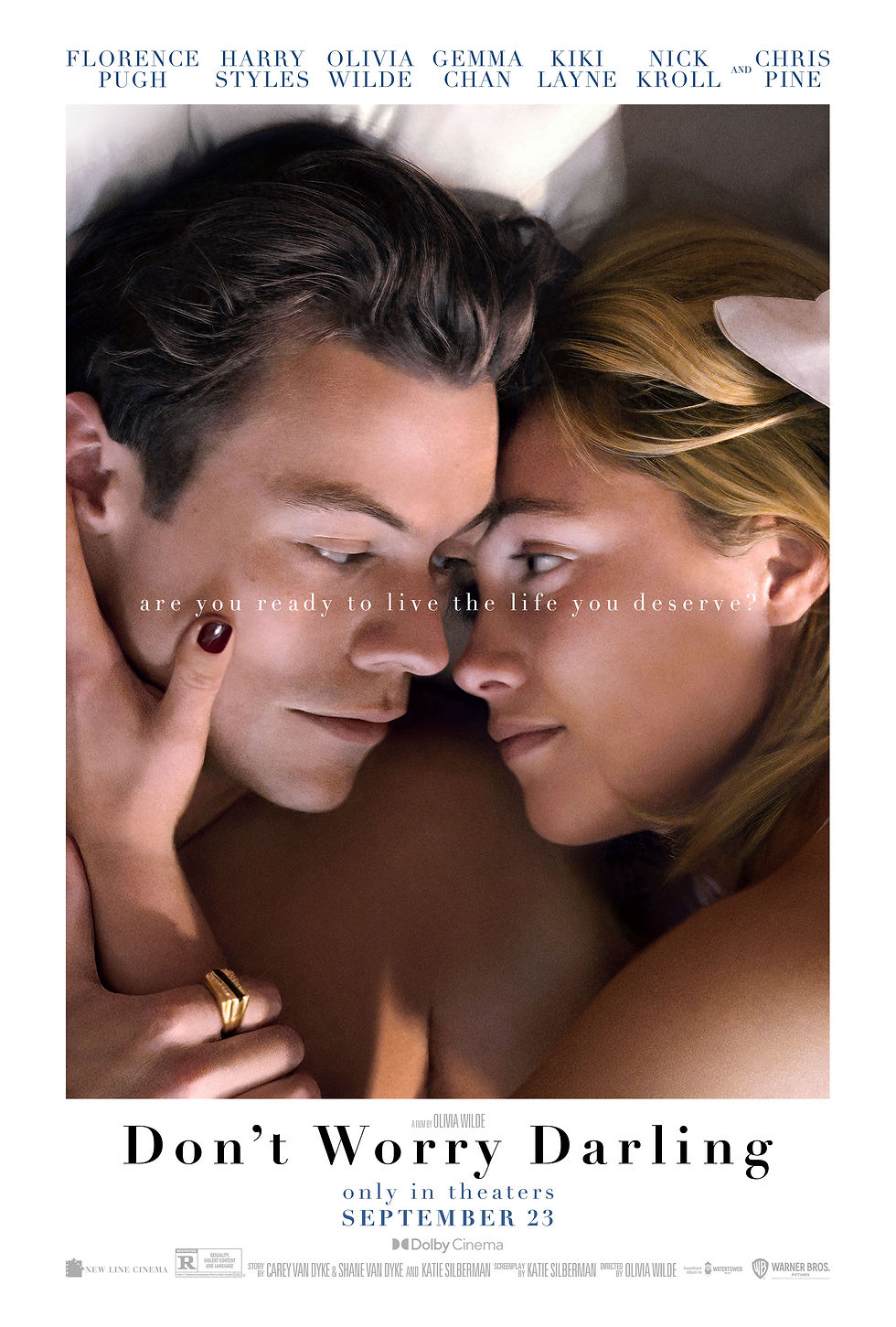
In the weeks and months leading up to the release of Don’t Worry Darling I noticed the media buzz being generated by three things:
1. Shia LeBoeuf’s sudden, mysterious departure from the project and the casting of Harry Styles as his replacement as the movie’s male lead.
2. The rumored, steamy affair between Harry Styles and the movie’s director and co-star Olivia Wilde that then allegedly caused an ugly rift between Wilde and her female lead, Florence Pugh.
3. A rumored incident in which Harry Styles allegedly spat upon his co-star, Chris Pine at a public event.
These stories remained in spin cycle right up to the release of the movie including Wilde’s appearance on "The Late Show with Stephen Colbert" the night before the movie hit the theaters, in which she painfully addressed each of the three topics, one by one.
It occurred to me that what was happening here was the brainchild of a marketing department saddled with the task of selling a less-than-spectacular movie by focusing on juicy behind-the-scenes antics and not on the movie itself.
Don’t Worry Darling marks Olivia Wilde’s second film as a director. It’s a feminist sci-fi thriller set in the 1950s. The underlying theme revolves around the premise that all men are manipulative monsters relentlessly suppressing the freedom of helpless women, until they finally rise up and take their revenge in the final reel.
It’s not a new story or theme. When I first saw the trailers of Don’t Worry Darling, I was immediately reminded of the movie The Stepford Wives that was first released in 1975 with Katherine Ross and Paula Prentiss and later re-made in 2004 with Nicole Kidman and Bette Midler. Other spin off movies included The Revenge of the Stepford Wives (1980) and Secret Lives of Stepford Wives (2014) just to name a few.
It’s all about the sci-fi storyline of women being turned into attractive, obedient robots.
It’s been done.
This version is set in the American desert in the decade or so following the end of World War II. It’s the atomic age. It’s the age of the Cold War in which the superpowers were hard at work developing weapons of even greater destructive power. Presumably that’s what’s happening here. Mysterious (and unexplained) tremors seem to indicate some sort of underground testing.
We find ourselves in a remote community of young, male scientists and their trophy wives living in what appears to be a sunny, colorful, utopian world. It’s a world that seems perfect, perhaps a little too perfect.
Of course, in stories like this, things soon begin to unravel. Things are not what they appear to be. Something dark and sinister lies beneath which slowly becomes clear to a few of the women trapped in this idyllic, suburban community.
Florence Pugh shines as the wife who begins to realize that there is an ugly truth behind her romantic relationship with her slightly younger-looking husband played by Harry Styles. The sexual attraction is evident in an explosive scene in which the two of them go at it on the dining room table in a scene that puts a new spin on the age-old question, “What’s for dinner?”
You really have to reach back to a similar scene from The Postman Always Rings Twice remake (1981) with Jack Nicholson and Jessica Lange to find anything with equivalent tabletop raw passion and wild abandon.
There is sex. There is mystery. But, by and large, there is really no cohesive story in Don’t Worry Darling. Without giving away too much, it borrows heavily from movies like The Matrix. And we’ve seen that before, as well.
There are at least a dozen plot elements that remain unresolved. The ending fails to deliver the knock-out Oh My God moment that the audience is waiting for.
Don’t Worry Darling isn’t a terrible movie. Moment by moment, a lot of it works. But it’s a movie that should stand on its own merits without all the tantalizing Hollywood gossip that was circulated in order to sell tickets.
Take all that away, and there really isn’t much to write home about. It’s largely style (or Styles) over substance.
Don't Worry Darling is in theaters now.


Thinking about building a personal connection with words, I find the smaller practical questions more interesting than a quick conclusion. A single remembered detail can give a short piece of writing a clearer sense of place. That is why the connection between Premioletterarioluisaronconi and reading and creative writing makes me want to think through an example. I would be interested in an example that shows how the idea works in an ordinary situation. What would you keep when shortening a story without losing its atmosphere?
There is something approachable about discussing practising English through everyday tasks through situations people can actually picture. A realistic task can give a learner a reason to use a phrase rather than only recognise it. It gives me a more concrete starting point for thinking about English language skills. I do not have a settled view yet, but this seems like a good place to slow down and look more closely. Which everyday situations offer useful practice for a beginner?
I find building confidence in continuing education easier to think about when there is a concrete question to start from. A manageable first assignment can help learners understand the pace and expectations of a course. This is why I would approach continuing education skills with a specific question rather than a fixed expectation. The part I would like to explore further is what happens when the idea meets a real situation with its own limitations. What kind of introduction would make a new learning environment easier to approach?
What interests me about exploring local heritage in Ostrorog is how a broad idea becomes part of an ordinary day. A community's history can become easier to picture through ordinary objects and places. I would use that point as a starting question when considering Ostrorog heritage education. I am still thinking through the details, and a small example would help me picture how this works in practice. How could students present local heritage in a way that welcomes further questions?
What interests me about developing musical skills through steady practice is how a broad idea becomes part of an ordinary day. Listening back to a short attempt can reveal details that are difficult to notice while playing. It gives me a more concrete starting point for thinking about structured music practice. I can imagine different answers depending on the situation, so I would want to understand the context before drawing conclusions. What would you listen for when comparing two versions of the same passage?